Raynaud treatment


flickr.com/ photos/pontonoi/ 4611723530

flickr.com/ photos/pontonoi/ 4611723530

Raynaud is a phenomenon that is characterized by fingers feeling numb/tingly and looking white. This is a fleeting response to cold or to wind.  It occurs when the blood vessels constrict due to environmental factors or it can also occur due to emotional distress.

Best treatment?

Avoidance!  Avoid cold weather and sitting under an air conditioning vent.  Wear gloves.

Medications.  Calcium channel blockers are a blood pressure medication that has also been found in some patients to help with symptoms.  There are side effects from the medication like headaches, swelling, dizziness, nausea, rash, fast heart rate.

So, as we embark into colder weather, keep those gloves handy!

Posted in General Medicine- Adults | Tagged , , , , , , , , , | Comments Off on Raynaud treatment

Yoga. Ohhhhmmmmm…

flickr.com/photos/- sophiamariewalsh /8022174798

flickr.com/photos/- sophiamariewalsh /8022174798

Can yoga reduce symptoms of depression and/or anxiety?  Yes! Multiple randomized controlled trials used various yoga interventions in diverse study populations.  It was found that yoga improves overall symptom scores of both depression and anxiety by 40%!

How great!  No adverse side effects from medicine.  Just, increased flexibility, more feelings of well-being, and less sadness.

In fact, there are groups recommending yoga.

Institute for Clinical Systems Improvement and the Canadian Network for Mood and Anxiety Treatments– recommend yoga as an effective adjunctive (add-on) treatment for those with depression.

The Veterans health Administration (the VA) and the US Department of Defense — recommend yoga to adjunctively help manage post-traumatic stress disorder (PTSD).

Work Loss Data Institute (worker’s compensation group) recommends yoga for occupational stress, PTSD, and major depressive disorder.

Posted in Emotional health, General Medicine- Adults, Uncategorized | Tagged , , , , , , , , , , , , | Comments Off on Yoga. Ohhhhmmmmm…

Teething medications to avoid…

babyTeething medication .  It sounds like a good idea. . . to make the mouth numb.  But, according to the U.S. Food and Drug Administration (FDA) the topical pain relievers are not effective because they wash out of the child’s mouth within minutes.  Also, the  FDA warned that if an excessive amount of lidocaine is used, the infants and young children can have seizures, severe brain injury and heart issues.

In addition, the FDA is advising AGAINST the use of over-the-counter topical teething medications for pain.

Want to learn more?  http://www.aafp.org/news/health-of-the-public/20140709lidocaineadvisory.html

Posted in medication issues, Pediatrics, Uncategorized | Tagged , , , , , , , , , | Comments Off on Teething medications to avoid…

Cervical cancer screening. Who gets them? How often?

Cervical cancer screening is easily done with a pap smear.  The pap smear has successfully reduced mortality from cervical cancer since it was introduced in mid 20th century.  We now know that nearly 100% of cervical cancer specimens will test positive for a virus called human papillomavirus (HPV). 

Who should be screened?

All women over the age of 21. 

How often?  At least every 3 years in those 21 to 29 and at least every 5 years in those older than 30 as long as the results are normal.  Some need more frequent screening–like those with HIV, immunosuppression, or those with history of abnormal pap smears. 

What is HPV?

It is a virus that is sexually transmitted.  It is thought that most sexually active people have been exposed to HPV in their lifetime.  Most people’s body clears the virus, but in some individuals the virus causes changes in the cells of the cervix which over time can change into cancerous cells. 

Why not start pap smears before 21?

We want the body to have a chance to clear the HPV.  Realistically-speaking, the median age of first sexual encounter is age 17.  Most HPV infections are transient and will become undetetctable within one to two years.  Only persistent infections are at risk for becoming cancer.  It takes many years for these cellular changes to occur, thus screening at age 21 is suggested.  If screening occurs earlier than age 1, this is likely to lead to unnecessary (and painful!) procedures in patients whom cellular changes were likely to clear without intervention.


Posted in Uncategorized | Comments Off on Cervical cancer screening. Who gets them? How often?

Measles.

I wish measles were a disease of the past.  I have been a practicing physician for 19 years and I have never seen measles outside of a journal.  But, I am on the lookout!

The CDC reports that the U.S. measles cases have reached their highest level in 20 years.  Between 1/1/14 and 5/23/14 there were 288 confirmed measles cases across the country.  Ohio recorded the largest number of measles cases at 138. 

Best treatment?  Prevention! 

  • Children get a MMR (measles-mumps-rubella) vaccine at ages 1 and 4. 
  • All adolescents who have not previously had 2 doses of MMR should get vaccinated. 
  • Adults
    • if born in 1957 or later should have documentation of more than one dose of MMR unless they have a contraindication to the vaccine or laboratory evidence of immunity to each of the 3 diseases
    • for those born before 1957, you can be considered immune to measles although immunity is not universal (and laboratory confirmation of immunity can always be done). 

Want more information?  www.cdc.gov is the best vaccine informational source.

Posted in General Medicine- Adults, infections, Uncategorized, Vaccines | Tagged , , , , , , , , , , , | Comments Off on Measles.

Obesity is the enemy.

Yes!  Severely obese individuals may lose as many as 14 years off their life.

20 previous studies were pooled and it was found that a body mass index (BMI) of more than 40 raised the odds of dying early from heart disease, cancer, and diabetes compared to people of normal weight (BMI 20-25).

The lead investigator of the U.S. National Cancer Institute study found that the death rates in severely obese adults were about 2.5 times higher than in adults of normal weight range. 

We know that not becoming obese will extend your life… it is unsure if after being severely obese if weight loss would markedly increase life span.

For more information on obesity, visit http://www.nlm.nih.gov/medlineplus/news/fullstory_147194.html

Posted in General Medicine- Adults, Uncategorized | Tagged , , , , , , , | Comments Off on Obesity is the enemy.

Mom was right! Eat your veggies.

Want to decrease your risk of dying? Eat your fruits and vegetables. The following information was garnered from a British study of 65,000 people for 12 years.

Eating seven or more portions of fruit and vegetables daily decreased risk of death from cancer by 25% and decreased risk of death from cardiovascular disease by 31%.

  • Vegetables have a greater “protective effect” than fruits have.
  • Canned fruit increased the statistical risk of death (I presume this is from the sugary syrup in the canned good)
  • Can’t eat seven servings a day? The study showed that one to three portions daily decreased the chance of death from any cause by 14%, three to five portions had a 29% impact, five to seven portions dropped the chances by 36%, seven or more portions produced a 42% decline in the risk of death.

The researchers noted that there are unmeasured “confounders” in the study and aspects that were not measured like salt and fat intake.

Posted in General Medicine- Adults, Uncategorized | Tagged , , , , , , , , | Comments Off on Mom was right! Eat your veggies.

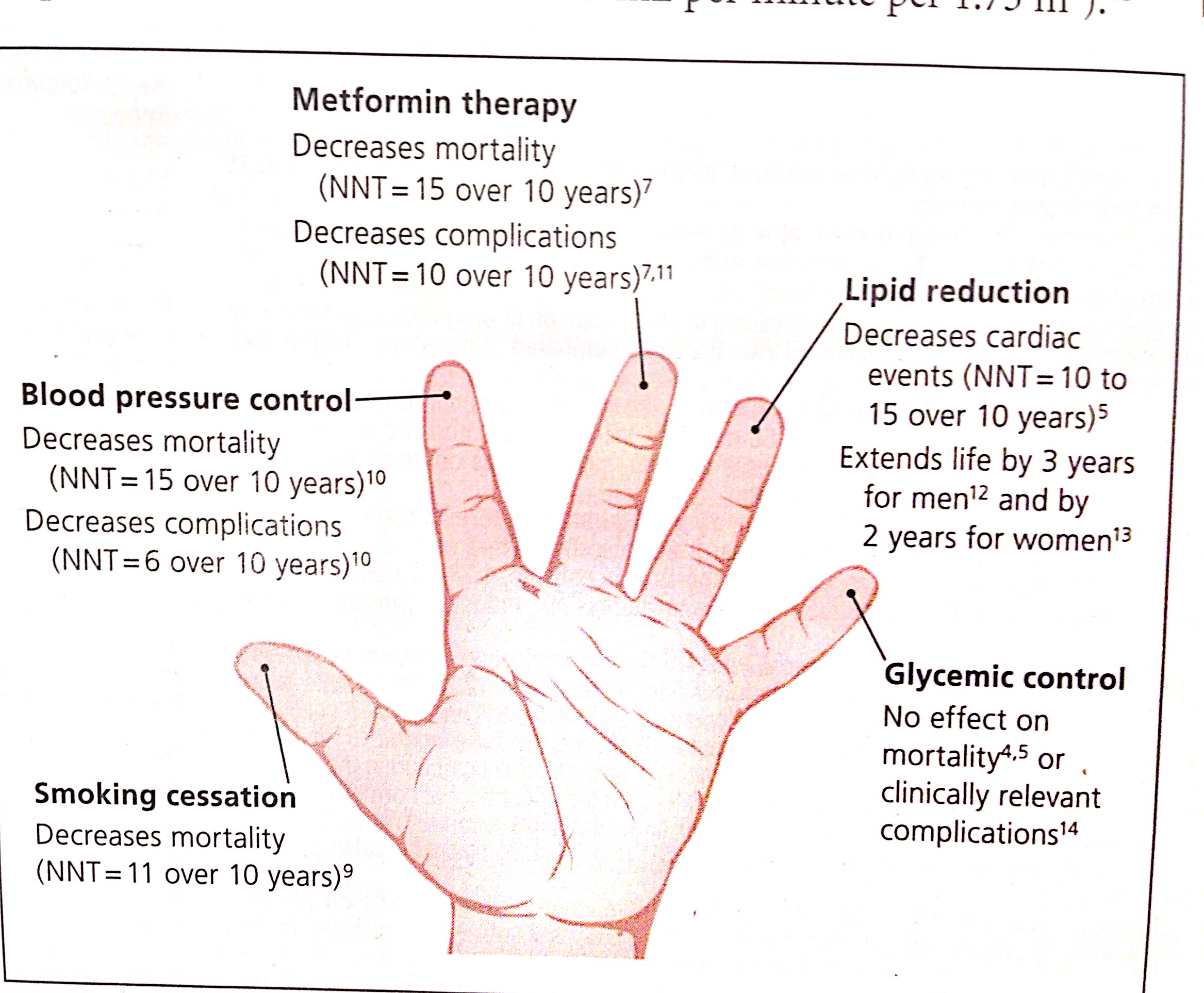
Great strategy: “Lend a Hand” to patients with diabetes

new doc 2_1Great strategy:  “Lending a Hand” to patients with diabetes

  1. Lend a hand?  Yes!  Each finger represents a way to help a diabetic.
  2. Stop smoking!  Tobacco poses a greater risk or morbidity and mortality than any other abnormality in diabetics.
  3. Control blood pressure.  Medication may be needed for this.  Goal: less than 140/90.  Metformin therapy.  This is known to delay premature mortality.
  4.  Cholesterol reducti8on.  Lifestyle changes with statin medication therapy is known to extend life by 3 years in men and 2 years in women.
  5. Lastly, blood sugar control.  Despite our focusing on blood sugars as an indicator of quality of medical care, the other “four fingers” may help more than blood sugar control.


Want more information? Lancet journal 2010; 375 (9713); pgs. 481-489.

Posted in Diabetes | Comments Off on Great strategy: “Lend a Hand” to patients with diabetes

Measles outbreak?!

flickr.com/photos /lessel/ 2729066

flickr.com/photos /lessel/ 2729066

Oh no!  The Centers for disease control and Prevention (CDC) is warning us physicians to remain alert for symptoms of measles.

Yes, this was once considered an “eliminated” infection.  But, as of May 30, 2014, a total of 334 confirmed measles cases has occurred over 18 states.  Measles is blossoming due to the importation of the disease from other countries AND an increasing number of U.S. parents who choose not to immunize their children with the MMR (measles-mumps-rubella) vaccine.

What should you watch out for?

  • Fever.
  • Red, splotchy rash that typically starts at the hairline and then moves down behind the ears and across the face.  Then it spreads over the rest of the body.

Treatment?

  • Isolation is key!
  • There is no antiviral treatment.
  • Medical care consists of symptom relief and prevention of bacterial infections on top of the measles.
  • The most common serious complication of measles is pneumonia.

Want more information?  http://www.aafp.org/news/health-of-the-public/20140609measles.html


Posted in Pediatrics, Uncategorized, Vaccines | Tagged , , , , , , , , , , , | Comments Off on Measles outbreak?!

Tattoos? Think before you ink.

flickr.com/photos/ bain/ 731005089

flickr.com/photos/ bain/ 731005089

As of 2012, 1 in 5 adults had a tattoo.  This is up from 14% in 2008.  Truthfully, tattoos are usually trouble-free.  But tattoos can pose health risks…

  • Unsterilized tools.
  • Contaminated ink.
  • Scarring.
  • Blood-borne diseases (HIV and hepatitis).
  • Toxins in the tattoo ink (metals, powders or other organic compounds).
  • Allergic reactions.

If you have a tattoo before getting an MRI let the radiologist know so that appropriate precautions can be taken.

Tattoos can also prevent early detection of skin cancer as the ink can camouflage changes in Asymmetry, Borders, Colors and Diameter–the ABCDs of melanoma detection.  So, do not cover up moles with tattoos.

Of note, the Food and Drug Administration regulates tattoo ink, but considers it a cosmetic and only intervenes when there are attention-getting problems.

Buyer beware.

Posted in General Medicine- Adults, Uncategorized | Tagged , , , , , , , , , , , , | Comments Off on Tattoos? Think before you ink.