Got an itch? Your doctor should be asking some of the following questions. . .

If you are itching, there is more to the story.  There are other parts to the history and physical to investigate.

Any new cosmetics or creams? They can cause allergic contact dermatitis, hives or even sensitivity to the sun.

New animal exposures?  Did they give you fleas? or an allergic reaction?

New medications, supplements or illegal drugs?  Hives can occur– or something called fixed drug eruptions.

Contact with sick people?  Let’s hope your vaccines are up to date.  You could have mumps, chicken pox, scarlet fever, fifths disease (the virus that causes cheeks to look slapped), rubeola, or folliculitis (an infection around the hair follicle shaft).

Unexplained weight changes, feeling hot/cold when others are not, changes in menstrual period?  This could be thyroid related and blood work will reveal it.

Unexplained weight loss with night sweats/fever and fatigue?   You also need blood work to rule out a cancer.

Nausea, “bone tired,” less urine output?  Blood work will show if you have kidney failure.

Recent travel?  A good skin exam may reveal lice, scabies, or hives.

A thorough history and physical is the detective work needed to help diagnose (and then cure) itching.

Hope this helps.
Posted in allergies, allergies, Dermatology, Dermatology, food, General Medicine- Adults, medication issues, medication issues, Pediatrics, Uncategorized | Tagged , , , , , , , , , , , , , , , , , , , , , , , , , | Comments Off on Got an itch? Your doctor should be asking some of the following questions. . .

Interesting political/medical turn of events.

Birth control pills and breast pumps without copays?  New rules start January 1, 2013.  Read on. . .

Insurers must cover birth control with no copays – Yahoo! News.

Posted in contraception, General Medicine- Adults, Obstetrics, Uncategorized, Women's Health | Tagged , , , , , , , , , , , , | Comments Off on Interesting political/medical turn of events.

Which smoking cessation interventions work best?

There are many options. Here are your effective options to stop smoking:

  • Nicotine Replacement therapy (like gum and patches): All forms of nicotine replacement therapy increased abstinence rates after 6 months. No one type of nicotine replacement can be suggested over another, as all were equally effective.
  • Buproprion. Average quit rate was 17% versus 6% for placebo at 6 months. Either 150 mg or 300 mg therapy worked well.
  • Nortriptyline. This antidepressant-type medication helped boost quit rate.

Of note, no evidence of improved quit rate with silver acetate, Nicobrevin (a nicotine-free smoking cessation aid), lobeline, or naltrexone.  Also, no high-quality studies showed effectiveness of hypnotherapy, acupressure or acupuncture for smoking cessation.

There are known benefits to counseling—individual, group, telephone session, online sessions. This increases quit rates and decreases relapse (starting smoking again) rates.

1-800-QUIT-NOW

Hope this helps.

Posted in General Medicine- Adults, lung conditions, nicotine, Uncategorized | Tagged , , , , , , , , , , , , , , , , | Comments Off on Which smoking cessation interventions work best?

Do you feel like you gush like a geyser when on your period? New medical help. . .

Heavy menstrual bleeding (menorrhagia) is common enough to cause 10 to 30% of women to seek a physician’s help.  Often the bleeding is severe enough to affect social and emotional well-being.  The current treatment options have been non-steroidal anti-inflammatory pills like ibuprofen, hormonal medications like “The Pill,” progesterone-only intrauterine device, and surgical procedures.

There was a multicenter, randomized, double-blind placebo-controlled study (oooh, aren’t those exciting words for you researchers and physicians out there) which compared tranexamic acid with placebo.  Tranexamic acid caused a reduction in blood loss per cycle over 6 cycles of 40%.  Maybe, better yet, the women in the tranexamic acid group improved their quality of life with fewer changes in social and physical activity due to menstrual flow.

The tranexamic acid is only given during the menstrual cycle and does not interfere with ovulation.  So, women who want to conceive can take this.  One caveat, the study was sponsored by the pharmaceutical company that makes the drug (no surprise).

The medication, brand name is Lysteda, is expensive, costing about $170 for 30 tablets.   Of note,  I do not own any stock in this product.

Hope this helps.

Posted in menstrual issues, Uncategorized, Women's Health | Tagged , , , , , , , , , , , , | Comments Off on Do you feel like you gush like a geyser when on your period? New medical help. . .

To mouth-to-mouth or to not mouth-to-mouth? That is the question. . .

Hopefully, you know I am referring to cardiopumonary resuscitation (CPR).   I have kept a mask to use for CPR in my car since medical school for exactly this task. There has been interest in whether CPR using chest compressions alone is comparable to outcomes of compressions plus rescue breathing.  Here is the newest answer. . .

There was a study published in New England Journal of Medicine with 1,941 patients which showed that there was no difference in survival to hospital discharge in those given rescue breaths in addition to compressions.  There was also no significant difference in having a “favorable neurologic status” (good brain functioning) with the addition of rescue breathing.   And, to go further, there was a better outcome in those receiving only chest compressions in those patients who had a cardiac cause of their cardiac arrest (instead of  choking or aneurysm rupture, etc).

So, if you are a bystander and see someone down, please do CPR.  It may save their life, a life with “favorable neurologic status.”   Consider taking CPR training.  The Red Cross offers classes nationwide.

Hope this helps.

Posted in General Medicine- Adults, Uncategorized | Tagged , , , , , , , , , , , | Comments Off on To mouth-to-mouth or to not mouth-to-mouth? That is the question. . .

Want more information on hepatitis C?

Hepatitis C  is a virus that may cause long-standing liver disease.  It is spread through the blood of a person with hepatitis C.  You can’t get it through casual contact—hugging, sharing utensils/drinking glasses, kissing, using public restrooms, sneezing, coughing or shaking hands.

 How will you feel if you have hepatitis C?  Most have no symptoms.  Some have flu-like symptoms like fatigue, nausea, body aches, weight loss, weakness, decreased appetite.  The virus may stay in your body for the rest of your life, even if you have no symptoms.  It can cause liver damage/scarring called cirrhosis. 

To decrease your risk, do not share needles or use illegal drugs.  If you have done either, you are at risk for Hepatitis C.  Ask your doctor about testing.  Do not share items that may have blood on them: toothbrushes, razors, combs, brushes, or nail clippers.  Sexual transmission is low, but latex condoms and limiting number of sexual partners helps decrease risk.

Is there a vaccine for hepatitis C?  No.  But, there are vaccines for hepatitis A and B.  If you have hepatitis C, the other two vaccines are suggested to decrease the risk of other infections affecting the liver.

Is there treatment for hepatitis C?  Yes.  There are medications  like interferon and ribavirin that may need to be taken for a year to help clear the infection.

What should I do if I have hepatitis C?  No medications should be taken that tax the liver (like acetaminophen) and no drinking alcohol. 

Will I infect others?  Hopefully not.  Wear a latex condom with intercourse.  Do not donate blood and don’t share personal items as above.

Want more information?  http://familydoctor.org/071.xml

Hope this helps.

Posted in General Medicine- Adults, infections, Uncategorized | Tagged , , , , , , , , , | Comments Off on Want more information on hepatitis C?

Tai chi, one pathway to a better life.

I have seen groups of people performing tai chi in the park and wondered what was the draw to (what seemed to me)… arm waving.  I know, I am unenlightened.  A recent internal medicine journal cites a study showing tai chi significantly improves heart failure patients’ quality of life.

Tai chi is actually a gentle, meditative exercise of flowing circular movements, weight and balance shifting, visualization, breathing techniques and focused internal awareness.   In one study, patient’s performed tai chi for one hour twice a week with an instructor and were encouraged to practice three times a week.

After 12 weeks the tai chi patients had

  • better mood scores,
  • less depression and
  • better exercise tolerance than those in a heart health education program only.

These studies spurn me to learn about complementary practices that I know little about.

Hope this helps.

Posted in Emotional health, General Medicine- Adults, heart, Uncategorized | Tagged , , , , , , , , , , , | Comments Off on Tai chi, one pathway to a better life.

Frogs do not cause warts.

I see warts commonly, today in fact. They are caused by the human papillomavirus (HPV). There are more than 100 types of HPV.  HPV infects the skin where there are nicks in the skin and causes cells to proliferate and make a thickened, warty bump. Risk factors include using communal showers or changing rooms, being a meat handler for a job (interesting, huh?), and having a weak immune system.  The HPV vaccine given to adolescents is targeted against genital warts, not to the HPV types that cause common warts.

Do not pick or scratch the wart.  You may spread the virus and get more warts.  Warts are harmless and usually resolve spontaneously within months to years. There are very few, large, high-quality studies to show effective treatments for warts. In those few studies, topical salicylic acid and cryotherapy (freezing with liquid nitrogen) have been found to be most effective.  There are countless home remedies, but none have showed much promise in good studies.

What should you do if you or your child has nongenital warts? You can be patient– as natural immunity will help clear the warts over time in most patients. Or try a tried-and-true method as above.

Your doctor can help.

Posted in Dermatology, Dermatology, General Medicine- Adults, infections, infections, Pediatrics, Uncategorized | Tagged , , , , , , , , , , , , , , | Comments Off on Frogs do not cause warts.

Recurrent yeast infections?

I have some women patients who fight frequent vaginal yeast infections.  There is a 6 month regimen of medication that will help eradicate recurrent yeast infections.

The definition of recurrent vulvovaginal candidiasis is at least four documented episodes within the last 12 months.  It affects 5 to 8 % of reproductive-aged women.  First, it is important to make sure that the patient does not have elevated blood sugars (diabetes), as this can predispose the patient to yeast infections. If elevated blood sugars are the problem, then treatment of diabetes is first order of business.

Randomized controlled trials show effective treatment involves weekly diflucan or itraconazole two pills a month for the entire six months.  This placed nearly 91% of patients into remission.

Hope this helps.

Posted in Uncategorized, Women's Health | Tagged , , , , , , , , , , , , , | Comments Off on Recurrent yeast infections?

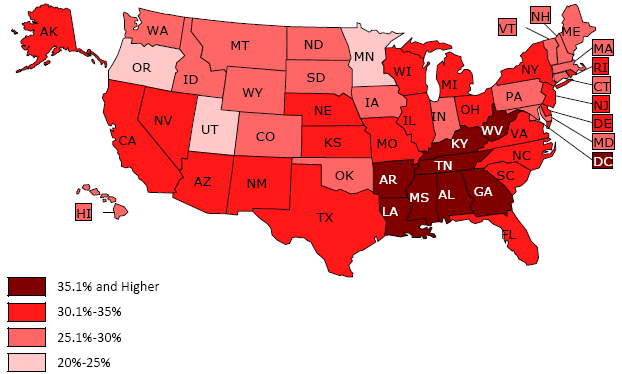
Childhood obesity. How to help your kids. . .

A recent study of obese 2-11 year olds reinforced some take home points that all of us parents with young children may appreciate. . .First the facts and then how we can change the culture in our own homes.

  • Limit sugar-sweetened beverages and give water instead.  Water is the best way to hydrate.
  • Offer healthy snack in lieu of cheese puffs or chips.  (This may mean that you need to purge the unhealthy snacks from your home).
  • Eat breakfast.  Like your mom used to tell you. . . it IS the most important meal of the day.

These three changes may greatly help your child build a healthy eating pattern and shed some fat, too.  Parents are gatekeepers of the foods kept in the home and offered.  Pick those foods responsibly.

Childhood obesity rates 2007

Childhood obesity rates 2007

Hope this helps.

Posted in food, obesity, Pediatrics, Uncategorized | Tagged , , , , , , , , , , , | Comments Off on Childhood obesity. How to help your kids. . .